

Financial Strategy
Under the 13th Three-Year Business Plan, we will execute capital allocation aimed at further growth and maximizing corporate value.
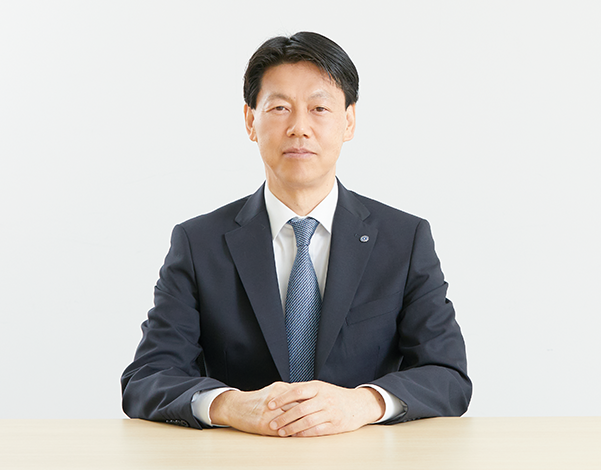
in charge of Finance & Accounting Department and
General Manager of Finance & Accounting Department
Munenari Mizukuchi
Overview of Operating Performance in Fiscal 2024
In Fiscal 2024, the Noritake Group’s consolidated operating performance resulted in net sales of 138.2 billion yen (an increase of 0.2% from the previous year), operating profit of 10.2 billion yen (a decrease of 4.6% from the previous year), and profit attributable to owners of the parent of 12.9 billion yen (an increase of 12.7% from the previous year). Net sales and profit attributable to owners of parent reached the second highest levels in history.
In Fiscal 2024, we made capital investments totaling 11.3 billion yen, more than double the previous year, including increased production capacity for MLCC materials and production expansion of heating furnaces for Li-ion batteries (LiB). Meanwhile, we also generated cash, including recording a gain of 3.5 billion yen from the sale of policy-holding shares. We have long advocated the policy of reducing policy-holding shares, and at the Board of Directors, we examined the appropriateness of continued holding for each individual stock, and proceeded to sell stocks with little rationality for holding.
Additionally, to strengthen shareholder returns and improve capital efficiency, we acquired treasury stock from August 2024 to February 2025 and subsequently retired them in March. As a result, the total return ratio reached a level close to 50%.
Review of the 12th Three-Year Business Plan
Fiscal 2024 was the final year of the 12th Three-Year Business Plan, which started in Fiscal 2022. Although both sales and profits increased over the three years, both fell short of the planned figures. I believe multiple factors contributed to this outcome. The main factor was that demand in the industries of major customers in the Industrial Products Business and Ceramics & Materials Business did not grow as expected. Additionally, inflation exceeded expectations, and not only materials and fuel but all costs increased. We also implemented base salary increases in response to the social trend of wage hikes. On the other hand, the momentum for price pass-through increased, and we promoted profit improvement and rationalization through price optimization and cost reduction. We recognize that circumstances not anticipated at the time of formulating the Three-Year Business Plan continued, and we were greatly affected by significant changes in the social and economic environment.
Promotion of Management Focused on Cost of Capital and Stock Price
Not only changes in the social and economic environment, but also changes in financial values were notable. Our Group has overcome challenging business conditions throughout its long history by tightening controls and monetizing company assets, aiming for long-term stable management. However, in order to respond to rapidly changing times, corporate management is now required to focus broadly on stakeholders such as shareholders, employees, the environment, and society. Companies are expected to efficiently utilize capital for growth investment, increase profits, return value to shareholders, and create new value for society. Our Group decided to transform itself in response to these changes in social values, aiming to become a growth company rather than a stable company, and to continuously enhance corporate value.
For fundraising, we will carefully examine the capital profitability of growth investments as a prerequisite. We will balance shareholder returns and growth investment, foster shareholder expectations for future profitability and growth, and promote management conscious of capital cost and stock price.
As a management indicator, ROE (Return on Total shareholders' equity) is considered important. Therefore, I believe it is essential to increase profits without excessively expanding total shareholders’ equity. We will eliminate unprofitable products and reduce fixed and administrative costs through business restructuring while being conscious of capital efficiency. Furthermore, it is necessary to quickly develop businesses and products with growth potential through investment.
Capital Allocation and Shareholder Return under the 13th Three-Year Business Plan
Operating profit during the 12th Three-Year Business Plan period reached 10 billion yen annually, greatly exceeding previous profit levels. Our Group has long held back from investment, so we will use the cash generated as a source to promote renewal of aging production equipment and facilities. By introducing new equipment, we will pursue rationalization and efficiency, as well as promote production increases and DX, transforming into a structure capable of generating profits.
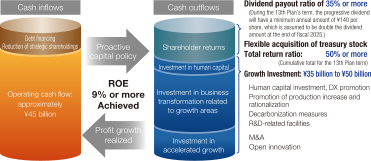
In the 13th Three-Year Business Plan, we expect to invest a total of 35 to 50 billion yen in growth investments, using not only operating cash flow but also funds raised through interest-bearing debt and the reduction of policy shareholdings. We will allocate sufficient funds to accelerate the commercialization of new business areas through research and development investments for new business development, M&A, and capital alliances.
To realize such a growth strategy, it is also important to enhance employee engagement. Taking recruitment perspectives into account, we will also expand investment in human capital to improve salary levels and strengthen development.
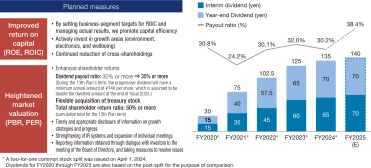
Regarding shareholder returns during the 13th Three-Year Business Plan period, we have set a policy to implement a progressive dividend with a payout ratio raised by 5% to a target of 35% or more, and to flexibly conduct share buybacks, aiming for a total return ratio of 50% or more over the plan period.
Expansion of Dialogue with Stakeholders
Since our stock price has risen about 2x over the past five years, we have attracted attention from investors both in Japan and overseas. We value opportunities for dialogue with all stakeholders, holding about 100 events per year such as financial results briefings and individual interviews. Since the insights gained from these opportunities are extremely valuable, we utilize them to establish indicators appropriate for our current situation, such as assumptions for capital cost and levels of shareholder returns, through ongoing discussions. In the 13th Three-Year Business Plan, we have set a goal of achieving an ROE of 9% or higher and a PBR surpassing 1.0 at an early stage. By steadily executing our business strategy, we aim to improve capital efficiency and corporate value.
The Noritake Group has embarked on a major transformation with a strong determination to pursue further growth. I kindly ask for your understanding and support as stakeholders.