

Human Resource Strategy
We are working to optimize our strategic talent portfolio and strengthen human capital in alignment with our management strategy.
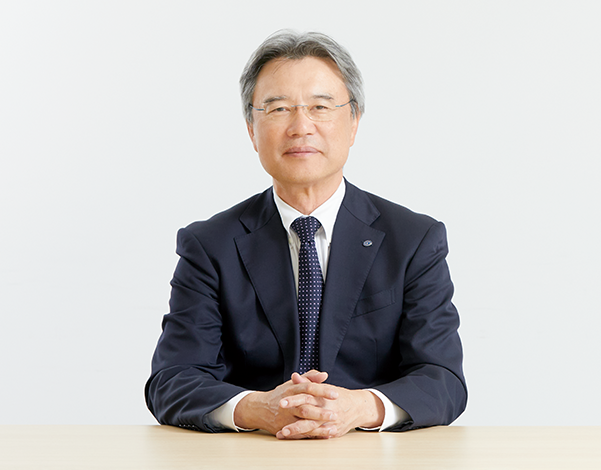
In charge of Human Resources Department
Makoto Okabe
Message
At Noritake, we are promoting a talent strategy to achieve our 2030 vision. In Fiscal 2024, we have mainly worked on three initiatives. The first initiative relates to the talent portfolio. We introduced a talent management system, classified talent types, identified the abilities and elements required by the organization, and created a talent portfolio aligned with our long-term vision. The second is the new personnel system introduced in Fiscal 2024. Previously, since seniority played a strong role and there was little differentiation in evaluations, we renewed the standards to enable more distinctive evaluations. The third is the improvement of employee engagement. The results of the engagement survey clarified issues for each department, led to improvement measures, and contributed to increased employee engagement. I also feel that the company’s awareness of employee engagement is increasing.
In the 13th Three-Year Business Plan, we also regard employees as important capital that generates added value for the company and will strengthen investment in them. In April 2025, we reorganized and made a fresh start as the Human Capital Management Department. Fulfilling the talent portfolio is our most important initiative, so we will continue to accurately assess talent types and levels and enhance the fulfillment of the portfolio. We will also further utilize the talent management system, and in the future, leverage talent data for development and optimal placement.
The new personnel system is entering the phase of improvement and establishment. We have already conducted two evaluations under the new standards, but found the issue that evaluations tended to cluster around the median more than expected. While improving the rating system and further promoting mindset reform, we will establish an environment where employees can work with a sense of satisfaction by providing appropriate and distinctive evaluations.
More than 1,200 employees participated in the townhall meeting with President Higashiyama in Fiscal 2024, and we are now in a stage of dialogue with business group leaders. This not only enhances employee engagement, but also helps uncover talent hidden in the workplace, so we intend to continue these efforts.
In addition, we are promoting various DE&I initiatives based on the recommendations of the Women’s Empowerment Task Force. In Fiscal 2024, we implemented a reverse nomination executive mentor system. Female managers nominate their mentors and can engage in dialogue and consultation, and we hope that continued activity will lead to the development of female executives. In anticipation of future talent shortages due to an increase in retirees and declining birthrates, we will build a system that maximizes the power of our people, including optimal placement through HR rotation and system improvements such as extending the retirement age.
Identity of human resources at Noritake
Noritake has applied and developed its ceramics technologies, cultivated through tableware production, in various ways, and has consistently created new value as society changes with the times and demands diversify.
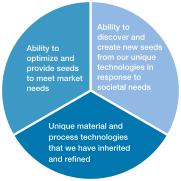
Our unique material and process technologies, which we have inherited and refined, serve as the source of value—or seeds—that we offer to society. We believe the identity of our human resources lies in the ability to optimize and provide seeds to meet market needs and the ability to discover and create new seeds from our unique technologies in response to societal needs.
Human capital strategy linked to business strategy
When formulating our human capital strategy, we first classified the human resources needed to execute our business strategy into several types and established our desired human resources portfolio.
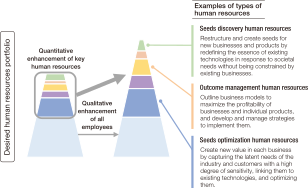
Through gap analysis comparing the current human resource portfolio (“As is”) with the desired state (“To be”), we established the following human resource strategy:
Human capital strategy
- ①Enhancement of human resource investment to achieve the target human resources portfolio
- ②Implementation of talent management system to secure and foster diverse human resources
- ③Revision of personnel system based on the roles and achievements of diverse human resources
- ④Internal environment improvement to increase employee engagement and maximize return on human capital investment
To measure the progress of our human capital strategy, we primarily monitor the following three indicators:
- 1.Number of personnel with cross-boundary experience
At Noritake, we believe that it is important to gain experience across multiple fields throughout one's career in order to develop the ability to manage results and profits. Therefore, we monitor the number of employees with this multi-disciplinary experience, which we refer to as “cross-boundary experience.” This career path is particularly encouraged for department heads and future leadership candidates, and we manage human resources intentionally to provide such cross-boundary experiences. - 2.Sufficiency of human resource types
We continuously monitor how well the various human resource types defined in the human resources portfolio are represented in each business, using this as a guide for recruitment and human resource development. - 3.Engagement score
To maximize the effectiveness of our investments in human capital, we monitor engagement scores and use them to address organizational issues.
Strengthening human resources investment
In addition to developing and strengthening our existing human resources, we will focus more on securing new human resources in order to achieve our desired human resource portfolio as outlined in our human resource strategy. To incorporate knowledge and specialized skills Noritake does not have, we will strengthen our organizational functions in strategic areas including organic and biotechnology, electronics and semiconductors, and specialized areas such as DX, marketing, finance and legal, by not only hiring but also utilizing outside organizations and personnel.
At the same time, we will invest more proactively in personnel system reforms and operations, as well as in talent management system operations, to promote the strengthening of our human capital base.
Talent management practices
Design and entrenchment of career path models
We support career design through career education and interviews with supervisors by presenting model career paths so that each employee can develop his or her career in a highly motivated and autonomous manner, while keeping in mind the type of human resources required as the goal.
Active rotation
Since Fiscal 2023, Noritake has fully implemented an internal rotation system. To enable employees to achieve the aforementioned career paths, we actively conduct rotations based on each individual’s preferences and aptitudes.
Utilization and promotion of the talent management system
From Fiscal 2024, we have fully implemented the talent management system and are advancing integrated management and visualization of talent data.
We will continue to improve and expand the system so that each employee can work in a way that suits their individual characteristics, including optimal placement and career development.
Revision and establishment of the personnel system
n April 2024, Noritake revised its personnel system.
Under the key themes of diversity, growth, challenge, leadership, and creating new value, the new system reiterates the expected work styles of employees, redefines job grades, and renews the evaluation criteria and standards.
Going forward, we will improve areas identified through system operation and promote retention among employees as a pillar of our talent strategy.