

Disclosure based on TCFD Recommendations
Since its founding, Noritake has operated its business under the basic philosophy of “contributing to society through business.” Conserving the global environment is a major issue for society and is positioned as one of the most important management issues for our company as well.
Therefore, in line with the TCFD recommendations, we identify climate change-related risks and opportunities, consider countermeasures, and reflect them in our management strategies.

TCFD
TCFD stands for Task Force on Climate-Related Financial Disclosures and was established in December 2015 by the Financial Stability Board (FSB) at the request of the G20. In June 2017, the TCFD released a report recommending the disclosure of information on risks and opportunities related to climate change, and companies and institutions around the world have endorsed the recommendations.
Scope of consideration
The business scope covered all major businesses, including Group companies, and the geographical scope covered Japan, which has a high proportion of sales, as well as the other major overseas areas.
The base year for the risk and opportunity assessment is set at 2030, when social changes towards a low-carbon society will have an impact on our business.
Reference scenarios
Reference is made to the IEA World Energy Outlook 2021*1 for transition risks and the SSP scenario*2 of the Intergovernmental Panel on Climate Change (IPCC) for physical risks.
*1 NZE (Net Zero Emission by 2050) for the 1.5°C scenario, APS (Announced Pledges Scenario) and SDS (Sustainable Development Scenario) for the 2°C scenario, and STEPS (Stated Policies Scenario) for the 4°C scenario
*2 SSP1-1.9 for 1.5°C scenario, SSP1-2.6 for 2°C scenario, and SSP5-8.5 for 4°C scenario
Governance
Under the Sustainability Management Committee, chaired by the President, the Environmental Committee leads the Noritake Group’s initiatives related to climate change. The Committee formulates unified guidelines for environmental protection activities, promotes these initiatives, manages progress, and implements corrective measures as necessary.
Strategy
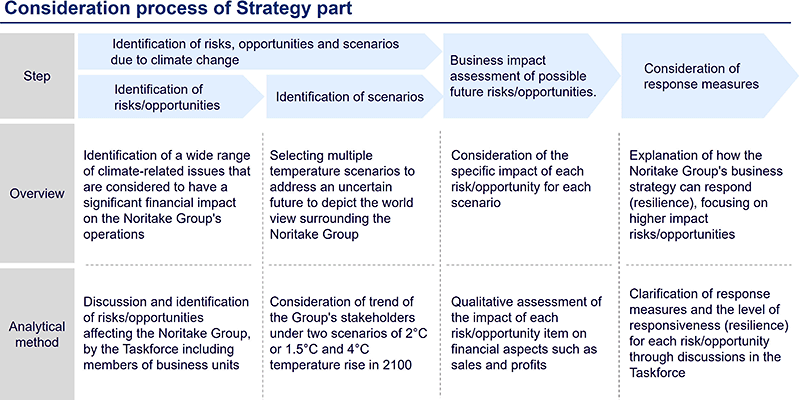
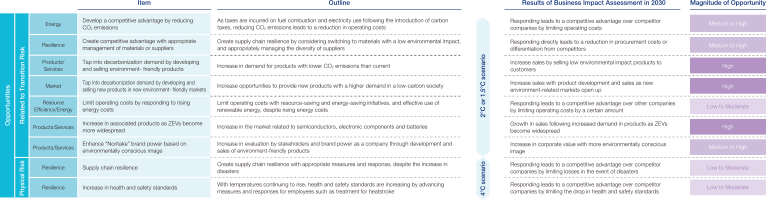
For the society in 2030, different impacts are expected depending on the climate change scenario. In the 2°C or 1.5°C scenarios, the impact of policy transitions is expected to be significant, while in the 4°C scenario, physical impacts such as weather are expected to be greater.
Our Group has examined risks and opportunities based on two scenarios: the “risks related to the transition towards a low-carbon society” which would occur during the progression to the 2°C or 1.5°C scenario, and the “risks related to the physical impacts associated with climate change” which would arise if the global fails to achieve adequate climate change mitigation measures and reaches the 4°C scenario.
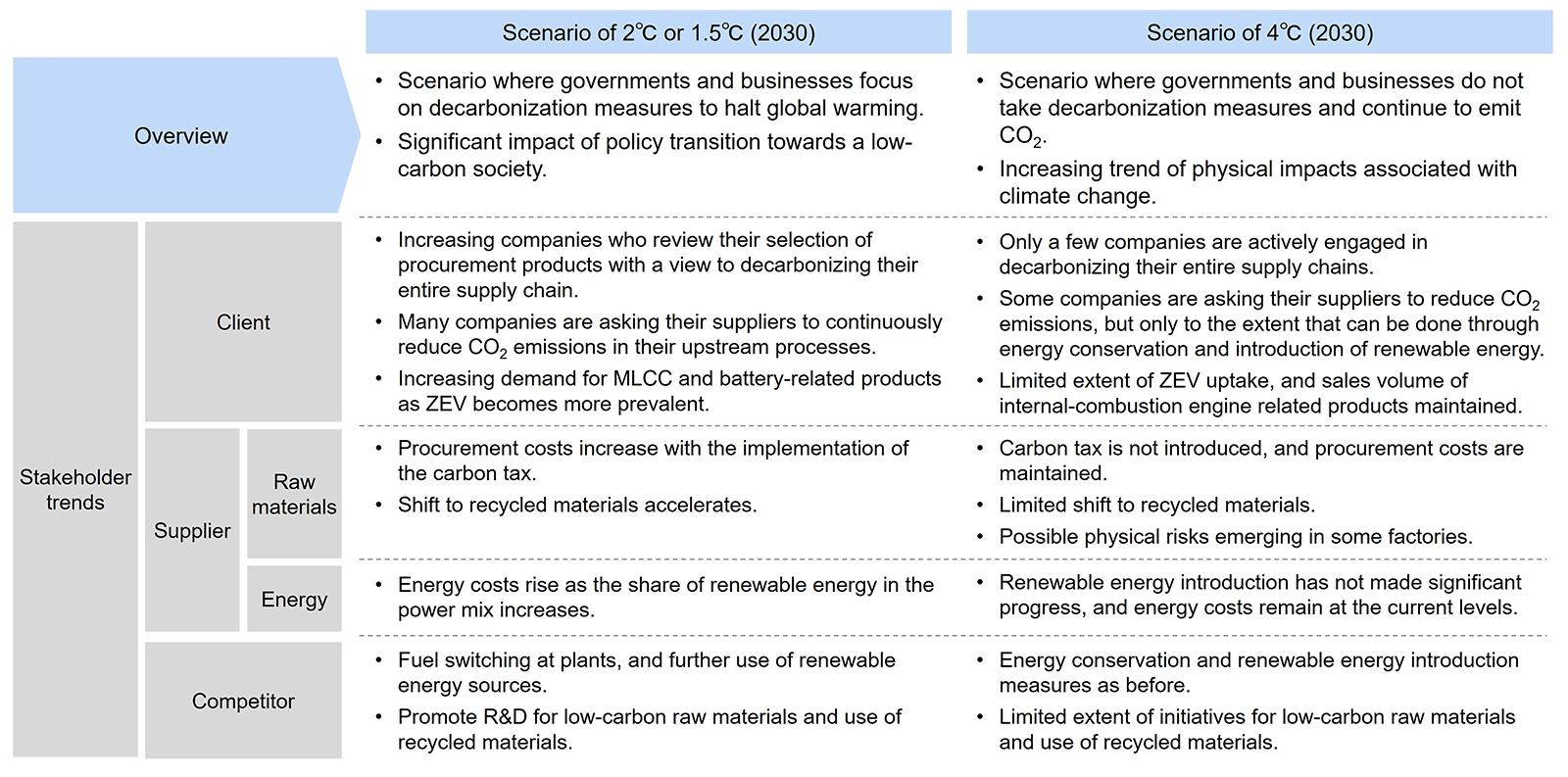
*1 Vision of society in 2030 under the scenario of an expected temperature rise of 1.5°C to 4°C by 2100
*2 ZEV: Zero Emission Vehicle
*3 MLCC: Multi Layered Ceramic Capacitor
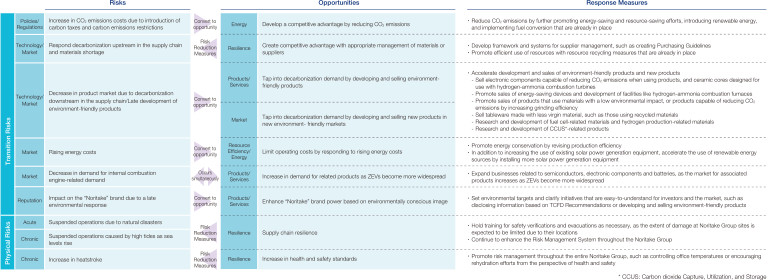
9 risks have been identified for the Noritake Group, and the magnitude of their impact in 2030 has been assessed as follows.
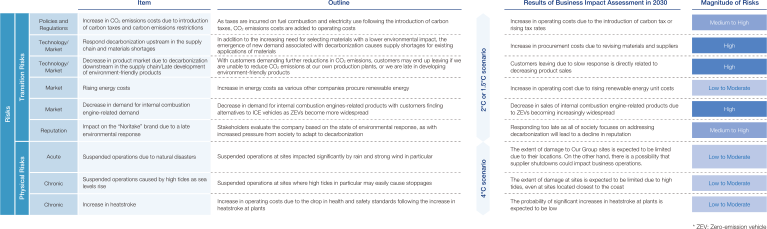
In contrast, the magnitude of opportunities impact in 2030 is assessed as follows.
The Noritake Group is required to take measures to turn risks into opportunities and to increase management resilience.
Risk Management
In regard to risks related climate change, a taskforce established in 2022 analyzed, assessed, and reported risks to the Board of Directors.
Going forward, the newly established Risk Management Committee in 2024 will take over these initiatives. The Committee analyzes and evaluates all risks of the Noritake Group, including climate change, identifies key risks, and manages initiatives to avoid or mitigate them.
Indicators and Targets
In order to transition to a low-carbon society and to achieve net-zero CO2 emissions by 2050, the Noritake Group has set targets to reduce its CO2 emissions (Scope 1 and 2) to 73,000 tons by FY2024 (25% reduction from FY2018) and to 49,000 tons by FY2030 (50% reduction from FY2018).
We will also review the method to calculate CO2 emissions from companies in the supply chain other than our Group companies (Scope 3), and set targets and examine the approach to achieve them.
Scope1, 2 (company's CO2 emissions) reduction plan